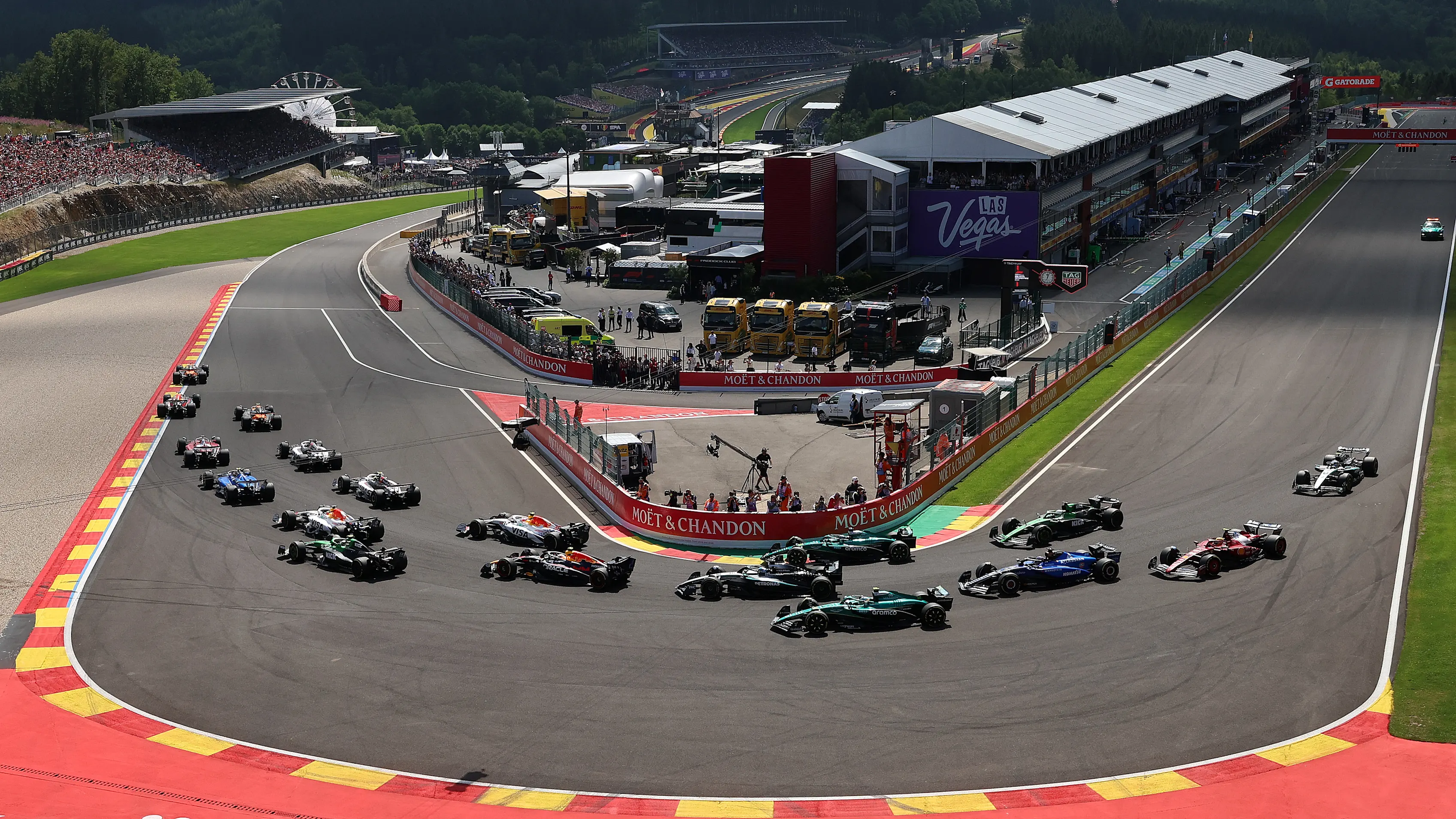
Like its fellow historic tracks in Monaco and Silverstone, the Circuit de Spa-Francorchamps has plenty of memorable corner names – but what do each of them mean? From the steep climb beginning at Eau Rouge to the lap-ending Bus Stop Chicane, we delve into the origins of every turn…
Turn 1 – La Source
At lights out, drivers speed down the short distance to La Source, which is the slowest corner on the circuit and has been the site of a few scary opening lap incidents, such as in 2012. Its name is linked to the numerous water sources in the region – a recurring theme amongst Spa’s corners.
Turns 2/3/4 – Le Raidillon de l'Eau Rouge
This is where the confusion can begin, as Eau Rouge doesn’t refer to the entirety of the iconic uphill climb. Meaning ‘red water’, it only encompasses the bottom of the hill and copies the name of a stream that passes beneath the track – high iron deposits in the soil give the water a distinctive red tint.
Raidillon (‘steep path’ in French) is the hill and its peak, reaching a maximum gradient of 15% to create one of F1’s most widely recognised corners. Watching the drivers zoom up is a spectacle in itself, but Mark Webber managed to pull off an audacious pass on Fernando Alonso here in 2011.
Turns 5/6 – Les Combes
After mastering the hill and flying down the Kemmel Straight – potentially a tribute to a Belgian village, but no one’s quite sure – racers tackle the chicane sequence of Les Combes, translating to ‘the valleys’ or ‘ravines’. This could indicate that the drivers have already passed the circuit’s highest point and head downwards for the rest of the lap. It was also the site of a stunning double overtake by Mika Hakkinen in 2000.
Turn 7 – Malmedy
Next up is the right-hander of Malmedy, named after a Belgian city. When officials first decided to host a race in the region in 1920, they settled on mapping out a circuit along the pre-existing roads linking Spa-Francorchamps, Malmedy and Stavelot.
Turn 8 – Bruxelles
This long right-hander can feel never-ending in the wet weather that frequents the Circuit de Spa-Francorchamps, and now honours Belgium’s capital city, Brussels. Some still call it by its alternative title of Rivage, which shares its name with a local hamlet.
Turn 9 – Jacky Ickx Curve
Time for a really contentious one – Turn 9. For years, it was known as The Corner With No Name, which wasn’t strictly true as it was previously labelled Speakers Corner for the tower that broadcast the race.
In recent years, it was renamed after legendary Belgian racer and multiple Le Mans winner Jacky Ickx, who competed in F1 between 1966 and 1979 and claimed eight victories.
Turns 10/11 – Pouhon
Pouhon can be roughly translated as ‘the place where the water is drawn from’ and alludes to the iron-rich mineral springs that have attracted tourists to the area for centuries.
The track has undergone so many modifications over the years that it’s unsurprising that many of its corners have a variety of names. French speakers sometimes call this section ‘Double Gauche’ which means ‘double left’ – fairly self-explanatory as it’s formed of two left-hand curves.
Turns 12/13 – Fagnes
The official title for Turns 12 and 13 is Fagnes, mirroring the name of the nearby Fen nature reserve in the Ardennes Forest which surrounds the circuit and offers a breathtaking backdrop for racing.
But if you want to fit in with the locals, you can call it Pif-Paf, French slang for the chicane’s rapid change of direction.
Turns 14/15 – Campus and Curve Paul Frere
Another one that has undergone different identities, the turn now known as Campus (a tribute to the local Campus Automobile education centre) used to be named Stavelot after a nearby town.
Curve Paul Frere has more straightforward roots – it honours a Belgian racing driver and journalist who drove in 11 Grands Prix during the 1960s, but is perhaps best remembered for his victory with Ferrari at the 1960 24 Hours of Le Mans.
Turns 16/17 – Blanchimont
The high-speed left-handers towards the end of the lap are named for a farm that sat near the track, reinforcing the circuit's connection to local Belgian landmarks.
Turns 18/19 – Bus Stop
Some call it The Bus Stop, others prefer the simpler name of The Chicane. Before one of its many redesigns, this final frantic section of track was a public road whenever there wasn’t a race, and a bus stop was located there.
It was removed ahead of the 2007 Grand Prix and the chicane itself was shifted slightly to create more space for the pit lane and start/finish straight.
Next Up
Related Articles
 Verstappen gets your vote after marathon in Malaysia
 OFFICIAL GRID: Who starts where for the Bahrain GP in Malaysia
 Verstappen wins Bahrain GP in Malaysia as Russell retires
/GettyImages-2297573553.webp) Wolff ‘not in a happy place’ after Russell Malaysia DNF
Wolff ‘not in a happy place’ after Russell Malaysia DNF What the teams said – Race day in Malaysia
  Verstappen ‘incredibly proud’ after historic Bahrain GP win